Batora.Game – Public Domain Registry customer – (Italy)
Game creators use .Game domains to present widely recognized titles across genres, platforms, and styles of play. Puzzle reinvention TetrisEffect.Game introduces music-driven gameplay and multiplayer expansion. Rhythm puzzle Lumines.Game continues the music-driven Lumines series. Sci-fi sandbox adventure CubicOdyssey.Game introduces expansive galaxy exploration and survival gameplay. Today, we highlight a choice-driven sci-fi adventure that combines combat, puzzles, and narrative outcomes: Batora.Game.
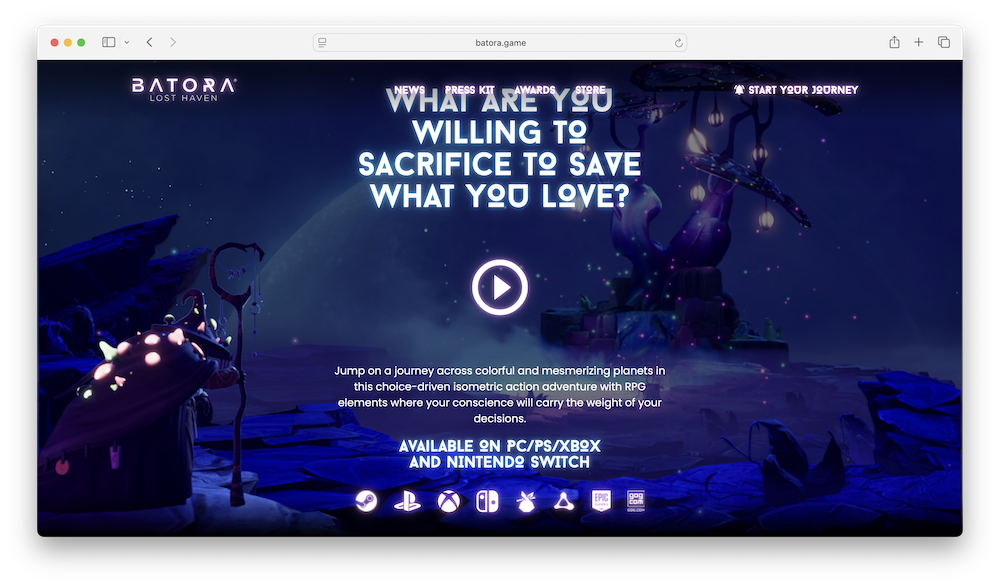
Batora.Game is the online home of Batora: Lost Haven, a choice-driven isometric action adventure with RPG elements developed by Italy-based Stormind Games and published by UK-based game developer and publisher Team17, whose catalog includes award-winning titles such as Overcooked!, alongside the Worms franchise and Dredge.1 According to Batora.Game, the game follows Avril, a young protagonist navigating a universe shaped by moral decisions, combat challenges, and narrative outcomes. The game is available on PC, PlayStation 4 and 5, and Xbox platforms, with additional releases available on platforms including Nintendo Switch,2 Amazon Luna, and the Epic Games Store.

Image via Batora.Game
According to Batora.Game, Batora: Lost Haven combines action combat with branching storytelling. The game introduces a duality system that affects multiple aspects of play, including combat, dialogue, puzzles, and endings. This system centers on the balance between Sun and Moon powers, which influence both gameplay mechanics and narrative direction.
As shared on Batora.Game, key gameplay elements include:
The story begins after a catastrophic event that leaves Earth in crisis. Avril becomes central to a mission involving interplanetary travel and decisions tied to survival and sacrifice. According to descriptions from the Stormind Games and Team17 websites, the narrative explores themes where moral boundaries are unclear and outcomes depend on player choices.
Core characters mentioned in official materials include:
According to official materials and announcements, Batora: Lost Haven has been recognized at several events:
Batora.Game provides a direct and consistent digital address for Batora: Lost Haven. The .Game extension indicates the website’s association with gaming-related content. As a short and intuitive domain, Batora.Game can support findability when users search for the game by name. Anyone who searches “batora game” or “batora lost haven” will find Batora.Game at the top of search results (as of April 7, 2026). You can learn more by following the game on X/Twitter, Facebook, and Instagram, joining the Discord, and visiting Batora.Game.
1. https://www.team17.com/our-history
2. https://www.gamespress.com/BATORA-LOST-HAVEN-LAUNCHES-ON-NINTENDO-SWITCH-TODAY
3. https://stormindgames.com/game/batora
Myosin.xyz – Squarespace customer – (United States)
Teams building AI-enabled blockchain infrastructure use .xyz domains to develop payment systems, data networks, and tools that support automated and agent-based workflows. Oracle network Switchboard.xyz powers decentralized applications with customizable data solutions. Crypto payment platform AEON.xyz develops payment infrastructure for AI-driven transactions. AI platform GizaTech.xyz explores Ethereum’s potential to increase the usage of machine learning. In this week’s #AIMonday, we’ll introduce you to an AI-enabled marketer platform combining go-to-market services with hands-on AI learning: Myosin.xyz.
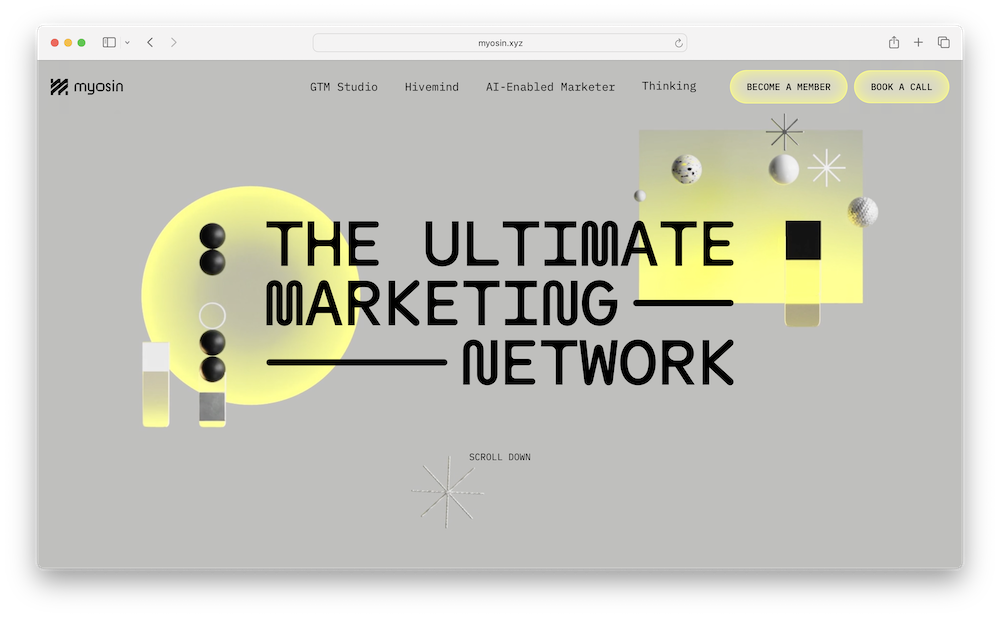
Myosin.xyz is the online home of Myosin, a go-to-market (GTM) studio and marketing network for crypto and onchain companies. According to Myosin.xyz, it operates as a combination of a product studio and a distributed network of marketers, designers, and strategists. The model connects companies with contributors from its community to execute campaigns and support user acquisition efforts across different markets. In addition to its GTM services, Myosin is developing product and education offerings. One of these is AI-Enabled Marketer, which is presented as a self-paced program for individuals interested in learning how to build with AI. According to Myosin.xyz, the program is designed to teach participants how to automate workflows, create AI-powered tools, and ship practical projects.
The AI-Enabled Marketer program focuses on hands-on outputs rather than theory. According to the curriculum overview on Myosin.xyz, participants are guided to build marketing automation workflows using tools such as AI orchestration platform n8n, develop simple applications and websites using models like Claude, and experiment with image generation tools. The program also includes a resource hub with prompts and templates, as well as a community component where members can collaborate and share projects.
Myosin was co-founded by Simon Yi and Blake Minho Kim. According to LinkedIn, Simon describes Myosin as an expert network that supports blockchain adoption and has worked with organizations such as the Stellar blockchain network, the Ripple payments protocol (XRP), and the NEAR smart contract platform. As shared on LinkedIn, Blake, who leads product and community, describes his role as building systems that connect GTM services, AI products, and contributor networks. In an April 2025 X/Twitter post, Blake shared that the network distributed over $180,000 to contributors for marketing work and described the structure as a DAO (decentralized autonomous organization) with a focus on collaboration, shared incentives, and ongoing product development.1
Myosin selected Myosin.xyz, a domain that reflects its focus on emerging areas such as AI-driven marketing workflows and blockchain-based growth strategies. .XYZ is widely used by projects developing new tools across AI and web3. Myosin.xyz offers a clear and flexible domain that aligns with Myosin’s work in go-to-market services, AI-enabled education, and contributor networks. You can learn more by following the platform on X/Twitter @Myosin_xyz and LinkedIn @myosin-xyz, and by visiting Myosin.xyz.
1. https://x.com/blakeminhokim/status/1912116488749654118?s=20
AltiusLabs.xyz – Cloudflare customer – (United States)
Teams across the blockchain ecosystem use .xyz domains to build core infrastructure for decentralized networks. Governance infrastructure platform Tally.xyz builds tools for token launches, capital formation, and onchain coordination. Modular blockchain platform EV.xyz develops infrastructure for application-driven blockchains. Blockchain payments firm Obita.xyz develops infrastructure for global fiat and stablecoin transactions. In this week’s #BlockchainThursday, we’ll introduce you to a blockchain infrastructure platform developing an execution layer to improve network throughput and scalability: AltiusLabs.xyz.
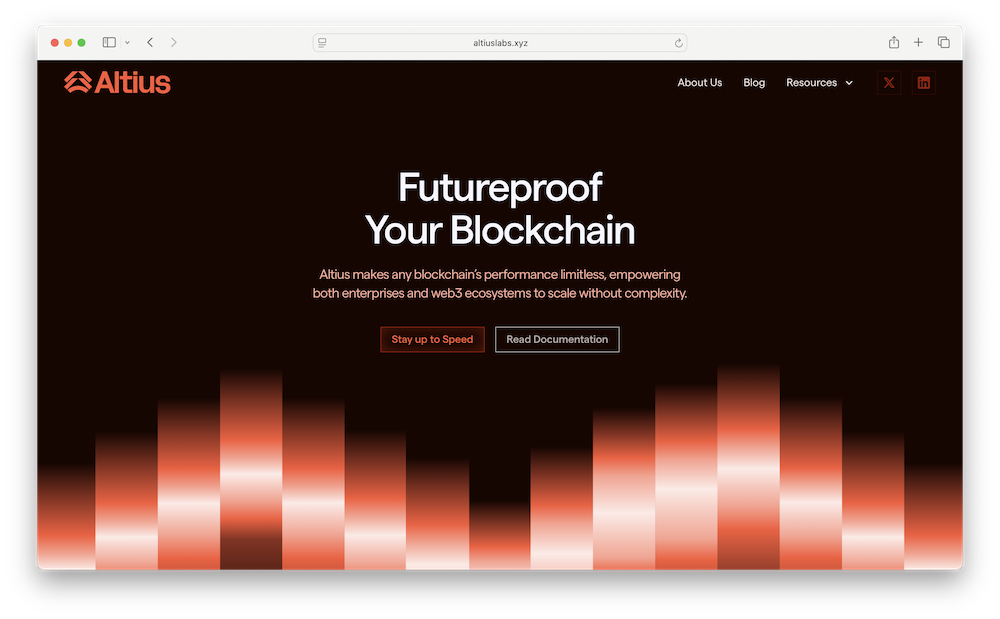
AltiusLabs.xyz is the online home of Altius Labs, a blockchain infrastructure company developing Altius, an execution layer designed to address throughput limitations (the amount of transactions a network can process per second) in existing networks. According to its documentation, the platform separates execution from consensus and storage, allowing transactions to be processed in parallel rather than sequentially. This design is intended to support higher transaction volumes while maintaining deterministic outcomes across nodes. In February 2025, Altius Labs announced an $11M pre-seed funding round co-led by Founders Fund and Pantera Capital, with participation from firms including Archetype, DCG, and Amber Group.1
According to its documentation, the platform is described as a modular execution engine that can integrate with Layer 1, Layer 2, and application-specific blockchains. The documentation also states that Altius is designed to function as a plug-in execution client or as the core engine for rollups and AppChains. Its architecture focuses on parallel execution, instruction-level processing, and in-memory state management to increase throughput. The system is also VM-agnostic, meaning it can support environments such as EVM, WASM, and Move without requiring changes to existing developer workflows. This approach is designed to support interoperability across different blockchain systems while maintaining flexibility for future standards.
Altius Labs also publishes educational content through its Learning Hub. One example, Stateless Blockchain Clients: How They Work & Why They Matter, explains an alternative approach to node operation where validators do not store the full blockchain state. According to the article, stateless clients rely on cryptographic proofs that accompany transactions, allowing nodes to verify state transitions without maintaining large local databases. This model can reduce hardware requirements for participants and may support more distributed network participation. The article also outlines trade-offs, including the need for efficient proof generation and increased data availability requirements.
According to LinkedIn profiles, the leadership team combines experience from traditional finance, high-frequency trading, and crypto infrastructure. According to his LinkedIn profile, Co-founder and CTO Anit Chakraborty previously worked as a software engineer at Hudson River Trading for over 15 years and earlier held a role at Oracle. Co-founder Annabelle Huang has a background in both crypto and traditional finance. As stated on her LinkedIn profile, she previously served as Managing Partner at Amber Group and has held roles at AirSwap and Nomura. Her experience also includes work across trading, risk, and growth functions within global markets.
Altius Labs operates on AltiusLabs.xyz, which aligns with its focus on blockchain infrastructure and execution systems. .XYZ is widely used by blockchain protocols, infrastructure projects, and developer-focused platforms. The domain hosts documentation, learning materials, and product information related to the Altius execution layer. Using AltiusLabs.xyz provides a single access point for developers and partners exploring the platform. You can learn more by following the company on X/Twitter and LinkedIn, joining the Discord, and visiting AltiusLabs.xyz.
1. https://www.cmointern.com/2025/02/altius-labs-raises-11m-to-revolutionize.html
KabinHotel.xyz – GoDaddy customer – (Japan)
The .xyz community includes organizations building tools, platforms, and practices that support sustainability across industries. Fashion supply chain platform Ympact.xyz supports traceability, data transparency, and impact measurement across global production networks. AI-powered platform Outfield.xyz transforms orchard management with drone technology and data analytics. Retail tech company EON.xyz collaborates with luxury brands to support transparent, sustainable commerce. In this week’s #WebsiteWednesday, we’ll introduce you to a Japan-based hospitality platform integrating sustainability practices into hotel operations: KabinHotel.xyz.
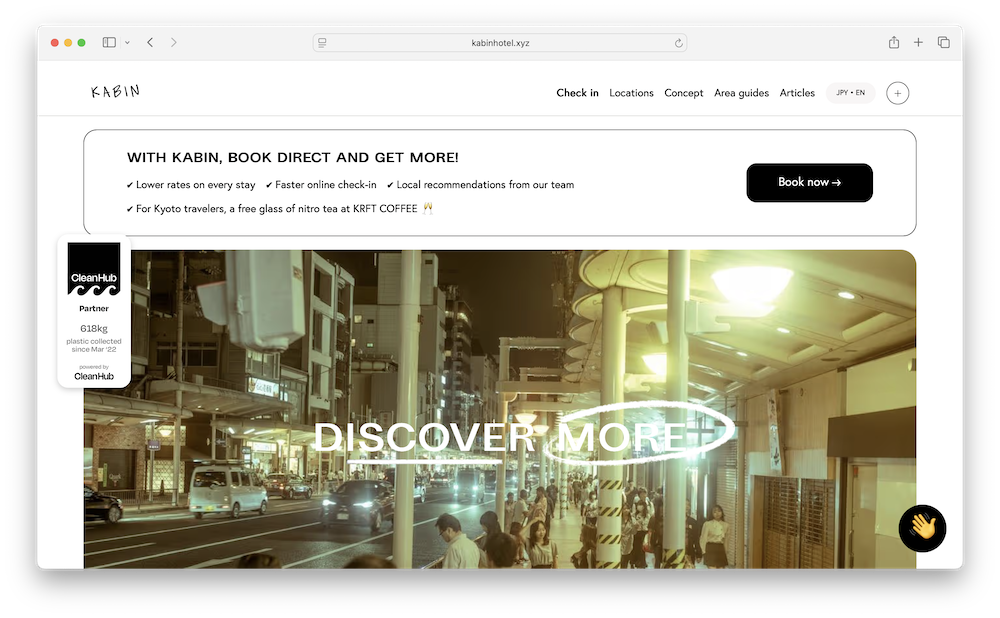
KabinHotel.xyz is the online home of Kabin, a hospitality brand and platform operated by Wayfarer, a company operating hotels in Japan and the United States. In April 2022, Wayfarer raised $1M to support its hospitality platform strategy.1 Additional coverage notes that Wayfarer has expanded its hotel operations in California, including locations in Downtown Los Angeles (2020)2, San Luis Obispo (2023)3, and San Diego (2023).4 According to the website, Kabin includes a network of properties across Kyoto and Osaka. KabinHotel.xyz shares that Kabin is designed for “next generation travelers,” offering digitally enabled stays located near central transit hubs. The platform combines accommodations with tools and services aimed at helping guests explore local neighborhoods while maintaining a consistent experience across properties.
The brand’s website highlights a portfolio of locations across Kyoto, including Kabin Kyoto, Kabin Koji, Kabin Machi, and Kabin Minamiza, as well as related brands like ORI and Wayfarer. These locations are positioned near key transit areas, which can support movement throughout the city. According to the website, the platform is designed around “community clusters,” where guests staying at one location may have access to shared facilities across nearby properties. The website also helps potential guests explore locations and book rooms, while registered guests can manage reservations, check in, and access their rooms through the Kabin mobile app (available on Apple App Store and Google Play). As described on the Concept page, the experience is intended to help guests “discover more things and get familiar with the city,” supported by local recommendations and services integrated into the platform.
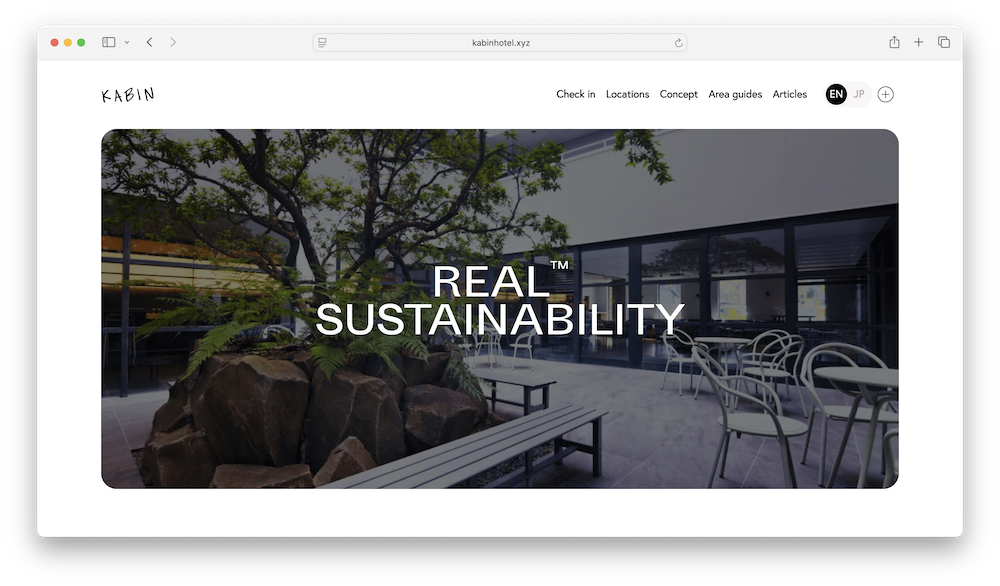
The Sustainability page states that sustainability is presented as an operational focus across Kabin’s hospitality model. The page also notes that a typical hotel stay can generate significant waste per night, and the company describes efforts to reduce this through changes in materials, amenities, and daily operations. These include reducing single-use plastics and offering reusable or lower-impact alternatives. The website also states that Kabin contributes to the collection of 200kg of plastic waste annually through a partnership with CleanHub. According to CleanHub, Wayfarer participates in initiatives aimed at preventing plastic waste from entering the environment and tracking material impact.5 The website describes these efforts as part of its operational approach to sustainability.
Leadership at Kabin is connected to Wayfarer, the company behind the platform. According to LinkedIn, Winston Chu is the Co-Founder and CEO of Wayfarer, where his work is described as “rethinking hospitality for next generation everyday travelers.” His background includes roles in investment and portfolio management across Hong Kong and Japan, informing the company’s approach to developing and operating hospitality assets.
The organization’s use of KabinHotel.xyz aligns with its globally oriented hospitality platform. .XYZ is used by organizations operating across regions and industries. In this case, KabinHotel.xyz is used by a Japan-based hospitality brand with an international audience. Kabin has also registered Kabin.xyz, a shorter domain that redirects to KabinHotel.xyz, providing an additional entry point for users navigating to the website. The domain can also support findability, as a search for “kabin hotel” places KabinHotel.xyz at the top of the search results page (as of March 26, 2026). You can learn more by following the hotel brand on Instagram and by visiting KabinHotel.xyz.
1. https://www.phocuswire.com/japanese-startup-wayfarer-snatches-1-million-to-become-aws-of-hotels
2. https://la.urbanize.city/post/taking-look-newly-opened-wayfarer-dtla-hotel
3. https://www.hospitalitynet.org/announcement/41009208/now-open-the-wayfarer-san-luis-obispo
4. https://usa.boutiquehotelier.com/wayfarer-san-diego-opening-news/
5. https://www.cleanhub.com/impact-report/wayfarer
XYZ Registry takes a firm stance against DNS abuse to protect our domain space. Over the past decade, we’ve developed an adaptive anti-abuse program designed to address emerging threats. Our team proactively identifies and mitigates phishing, malware, spam, and other forms of abuse across our TLDs, working with trusted cybersecurity partners to enforce our Anti-Abuse Policy and maintain trust across our namespaces.
Effective abuse mitigation depends not only on detection, but on coordination across the internet ecosystem. Registries, registrars, hosting companies, security researchers, and commercial platforms all play a role in identifying and responding to threats.
This quarter, we are highlighting the importance of consistent and responsible reporting of abuse. Detection capabilities across the industry have continued to improve, and many organizations, including cybersecurity vendors and commercial platforms, are increasingly effective at identifying abusive domains and malicious activity. However, detection alone is not enough to mitigate harm.
Timely reporting remains a critical step in the abuse response lifecycle. When actionable intelligence is not shared with the responsible registry or registrar, opportunities to remediate abuse can be delayed or missed entirely. In some cases, organizations may identify abusive activity but do not consistently report it through established enforcement channels.
XYZ Registry accepts abuse reports through several channels to ensure that bad actors are flagged and acted upon efficiently. A public-facing form on our website (https://gen.xyz/abuse) provides an accessible intake point for anyone to submit reports about domains involved in phishing, malware distribution, spam, or other harmful activity. XYZ also receives reports through direct email [email protected], as well as via established industry threat feeds. Additionally, XYZ participates in coordinated reporting relationships with security platforms and other trusted notifiers, and offers automated methods for reporting, enabling a more structured format for entities who can report at scale. XYZ has joined the Trusted Notifier Network (TNN), in anticipation of expanding this network even further.
We can collectively reduce harm and strengthen trust across the internet by improving how abuse is reported and acted upon. Organizations that hold actionable threat data have a meaningful role to play, and integrating and sharing it makes the broader ecosystem stronger for everyone.
The Anti-Abuse Quarterly is published to the XYZ Registry Anti-Abuse hub on https://xyz.xyz/abuse. Visit to learn more about our monitoring process, find information on how to report abuse, and understand the actions we take in collaboration with industry partners and law enforcement.
As we continue to safeguard our domain space, these resources serve as a testament to our unwavering commitment to a safer internet. We encourage you to join us in the ongoing fight against online abuse.
To report abuse of .xyz or any XYZ Registry TLD, please open a ticket at https://gen.xyz/abuse or email [email protected].