posted by Team XYZ on October 27, 2026
Foundation.Game – GoDaddy customer – (Switzerland)

TL;DR:
- Foundation.Game is the official website for Foundation: Galactic Frontier, a free-to-play sci-fi strategy game set in the universe of Isaac Asimov’s Foundation novels and the Apple TV series based on them.
- Game company FunPlus developed the game, which is officially licensed in collaboration with the Apple TV+ series Foundation and its production company, Skydance, according to the game’s FAQ.
- Foundation: Galactic Frontier launched globally in October 2025 and has been covered by independent outlets such as Pocket Gamer, Screen Rant, and Inverse.
Foundation.Game Overview
- What: Foundation: Galactic Frontier is described on its FAQ as a sci-fi space strategy RPG with an original storyline set within the established Foundation universe.
- Who: FunPlus, a game company founded in 2010, developed the game at its Chengdu studio, according to its launch announcement.
- When: FunPlus revealed the game in March 2024 and opened an Android soft launch in select countries in September 2024, followed by a global launch on October 21, 2025.
- How: Players take the role of an interstellar trader, building a fleet and recruiting a crew while navigating rival factions as the Galactic Empire declines. The game is free to play with optional in-app purchases, and supports shared progress across Windows, macOS, iOS, and Android.
In The News
- In September 2026, Pocket Gamer covered the launch of the game’s second season, The Usurper Rebellion. The update centers on Sivana, a new province ruled by a self-proclaimed Emperor, and adds a guild PvE mode.
- In August 2026, Screen Rant covered the game as fans awaited the fourth season of the Apple TV series. The outlet described it as a free-to-play title mixing real-time strategy with base building, character collecting, and isometric combat.
- In March 2026, Inverse examined how the game draws on both Isaac Asimov’s novels and the Apple TV series. The article noted that characters such as Hari Seldon combine details from the books with the look of the show.
- In October 2025, Pocket Gamer reported the game’s launch on iOS and Android. The outlet noted that players can take on roles such as trader, bounty hunter, or political strategist, and deploy crew members in teams of three.
Foundation.Game Leadership
Foundation: Galactic Frontier is developed by FunPlus, whose leadership team includes:
- Andy Zhong: CEO and Co-Founder
- Terry Lin: Chief Financial Officer
- Tao (Edge) Wu: Co-CTO
- Alexandre Amancio: SVP World-Building & IP Strategy
- Dianne Schepers: VP General Counsel – Western Markets
- Bob Slinn: VP Business Development
- Eleanor Twilton: VP Global PR and Communications
- Frauke Grabow: VP HR Europe
Connect with Foundation.Game
Why .Game is a great choice for Foundation.Game
- The .Game extension connects Foundation.Game directly to the gaming industry, giving Foundation: Galactic Frontier a short, descriptive domain that reflects its focus.
- The availability of names on .Game allowed the team to secure Foundation.Game, pairing a recognizable franchise name with an extension dedicated to gaming.
- Foundation.Game provides a dedicated online home for the game, bringing Windows, macOS, iOS, and Android downloads together under one domain, separate from FunPlus’s corporate website.
More gaming innovation from the #GenXYZ community
- Cooperative adventure BigWalk.Game turns a big open world into a hangout for friends
- Early Access roguelike UnderMine2.Game brings branching dungeon paths to the UnderMine series
- Award-winning racing series Drive.Game brings multi-platform rally racing to the #DRIVE franchise
posted by Team XYZ on October 26, 2026
TheProductGuy.xyz – Cloudflare customer – (India)
TL;DR:
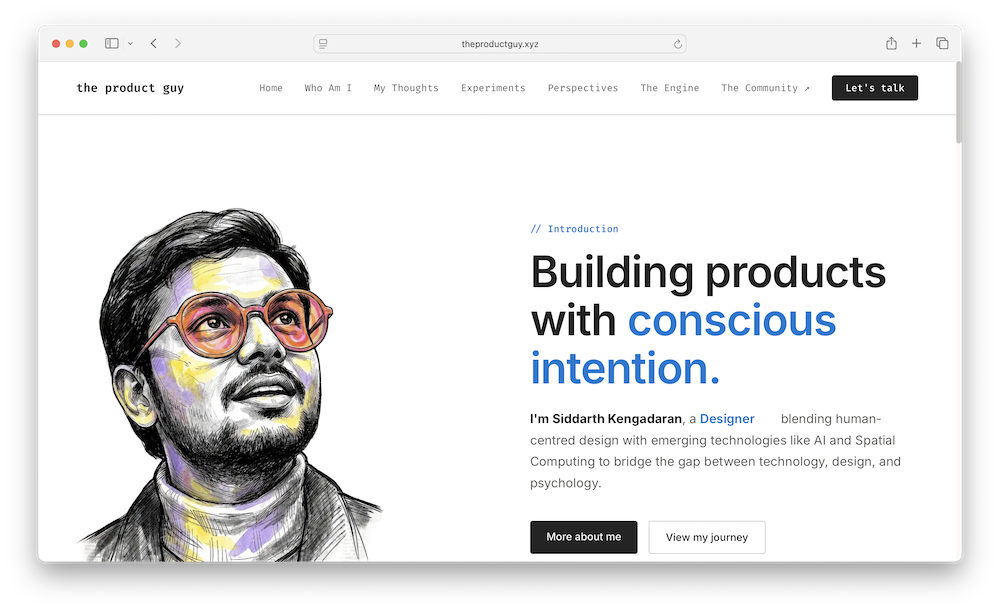
- TheProductGuy.xyz is the personal website of Siddarth Kengadaran, a product strategist in Coimbatore, India, who writes about how product work changes as AI takes on more of the building.
- The website highlights The Two-Speed Engine, Siddarth’s framework for sorting which software practices endure, transform, dissolve, or emerge in the AI era.
TheProductGuy.xyz Overview
- Who: Siddarth Kengadaran describes himself as a Product Strategist who blends human-centered design with emerging technologies like AI and Spatial Computing, and he works as an Experience Strategist at BayOne Solutions, according to the Experience section of his LinkedIn profile.
- What: Siddarth uses TheProductGuy.xyz to publish essays on product strategy, design, and AI.
- How: The website organizes Siddarth’s writing and perspectives into dedicated sections, and features interactive sticky notes showcasing his skills across strategy, design, agile, and technology.
- Where: Coimbatore, Tamil Nadu, India, as identified on his LinkedIn profile.
- Why: Siddarth frames his work as bridging technology, design, and psychology.
Exploring TheProductGuy.xyz
- The Two-Speed Engine: Siddarth’s framework models software development as an outer loop at human-judgment speed and an inner loop at machine speed.
- The framework’s Ledger component audits each software practice by asking whether it existed because of human judgment or human throughput, then marks it as enduring, transforming, dissolving, or emerging.
- The Two-Speed Engine includes an implementation playbook, a worked example that takes one app from brief to finished product, and a three-minute explainer video.
- Siddarth also publishes essays on TheProductGuy.xyz that cover AI topics, including “Jev, Explained Simply” and “The Designer in the Age of AI.”
- Readers can subscribe to The Digest, Siddarth’s newsletter covering product strategy, AI agents, and design.
Connect with TheProductGuy.xyz
Why .xyz is a great choice for TheProductGuy.xyz
- The availability of .xyz domain names helped Siddarth secure the memorable domain TheProductGuy.xyz, giving him an online identity that matches the handle he already uses across his profiles and a distinctive home for his writing that can evolve as his interests, expertise, and subject matter expand.
- .XYZ is a popular domain ending among startups and technology projects in AI and other emerging fields, a fitting home for writing focused on AI and agentic workflows.
- As a globally recognized extension, the .xyz domain gives India-based Siddarth a web address suited to sharing his writing and AI-era frameworks with product teams worldwide.
More AI-focused websites from the #GenXYZ community
- Researcher Lennart Heim uses Heim.xyz to explore the complexities of AI governance
- Award-winning AI Engineer RyanKlapper.xyz uses his .xyz to highlight enterprise deployments, independent builds, and more
- TechCrunch-featured founder JoelHernandez.xyz uses his .xyz to document startup ventures, product leadership roles, and AI projects
posted by Team XYZ on October 22, 2026
VolumeDAO.xyz – GoDaddy customer – (Taiwan)
TL;DR:
- VolumeDAO.xyz is the online home of Volume DAO, a Taipei, Taiwan-based collective of artists, curators, and collectors working at the intersection of blockchain and generative art.
- Since forming in 2021, the collective has curated exhibitions at Taiwanese museums such as Hong-Gah Museum and New Taipei City Art Museum (NTCAM).
- Volume DAO’s exhibitions with Tokyo gallery NEORT++ have drawn coverage from art research platform Fakewhale.xyz and Japanese art publication Artscape.
VolumeDAO.xyz Overview
- What: Volume DAO is a collective focused on blockchain art and generative art, with activities spanning artistic practice, collecting, research, and education. “Volume” refers both to sound and to a unit of collection, such as a volume or edition, according to its About Us page.
- Why: Volume DAO aims to advance the development of digital and generative art in Taiwan and internationally.
- When: Co-founder You-Sheng Zhang started Volume DAO with artists and collectors in October 2021, according to his biography on Civic Creative Base Tokyo.
- Where: Taipei, Taiwan.
- How: The collective organizes exhibitions, collects artworks, and hosts educational and community events that bridge onchain and offchain art audiences.
In The News
- In July 2025, art research platform Fakewhale.xyz reviewed “Silver Trail,” a curatorial project from Tokyo art gallery NEORT++ and Volume DAO that builds on their 2024 traveling exhibition, dialog().
- In December 2024, Artscape covered the Taipei edition of dialog(), which Volume DAO hosted at Taiwan Contemporary Culture Lab (C-LAB) from October 11 to 20, 2024. The exhibition featured approximately 40 works from artists across Tokyo, Taipei, Seoul, and Beijing.
Inside VolumeDAO.xyz’s “In the Flux of Us” Exhibition
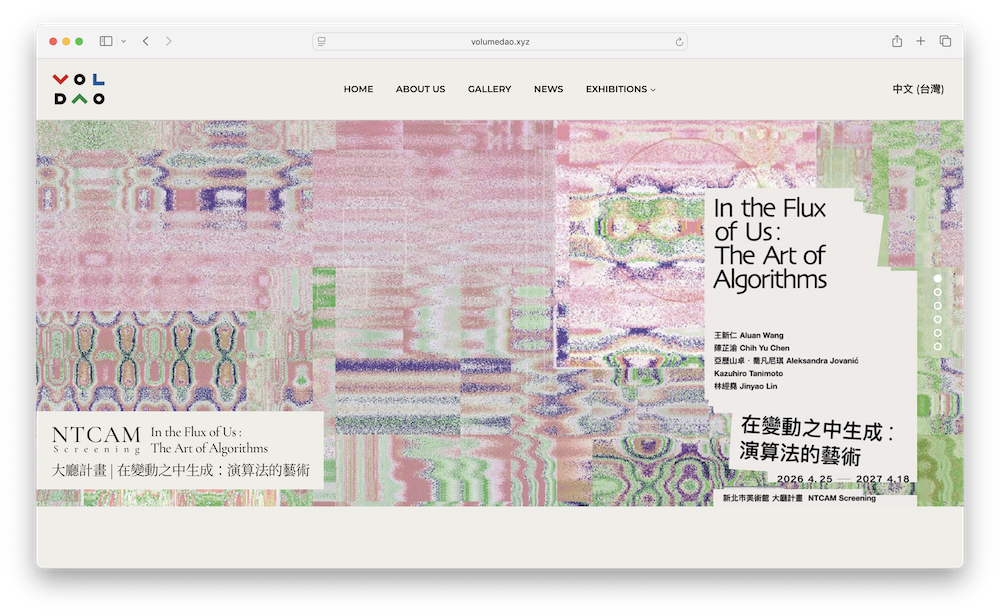
- NTCAM Screening: Volume DAO curates “In the Flux of Us: The Art of Algorithms,” which turns the NTCAM lobby’s LED screen into a space where visitors adjust generative works from their phones. Five artists rotate through the program, which opened in April 2026 and runs until April 18, 2027.
VolumeDAO.xyz Leadership
Connect with VolumeDAO.xyz
Why .xyz is a great choice for VolumeDAO.xyz
- As the domain of choice for many web3 and crypto projects, .xyz signals Volume DAO’s onchain roots and places the collective squarely in that community.
- As a globally recognized domain extension, .xyz suits a collective whose exhibitions and partnerships reach from Taipei to Tokyo, Seoul, and Beijing.
- .XYZ’s open, generic nature gives Volume DAO the flexibility to present its artistic practice, collecting, research, and education under one domain.
More blockchain innovation from the #GenXYZ community
- Woman-led financial platform AvalonFinance.xyz develops Bitcoin-backed lending and stablecoin solutions
- Web3 marketing agency Distractive.xyz brings crypto-native strategy to blockchain brands
- Real-world asset network Pharos.xyz combines modular infrastructure with built-in compliance for onchain finance
posted by Team XYZ on October 21, 2026
Accretion.xyz – Namecheap customer – (Singapore)
TL;DR:
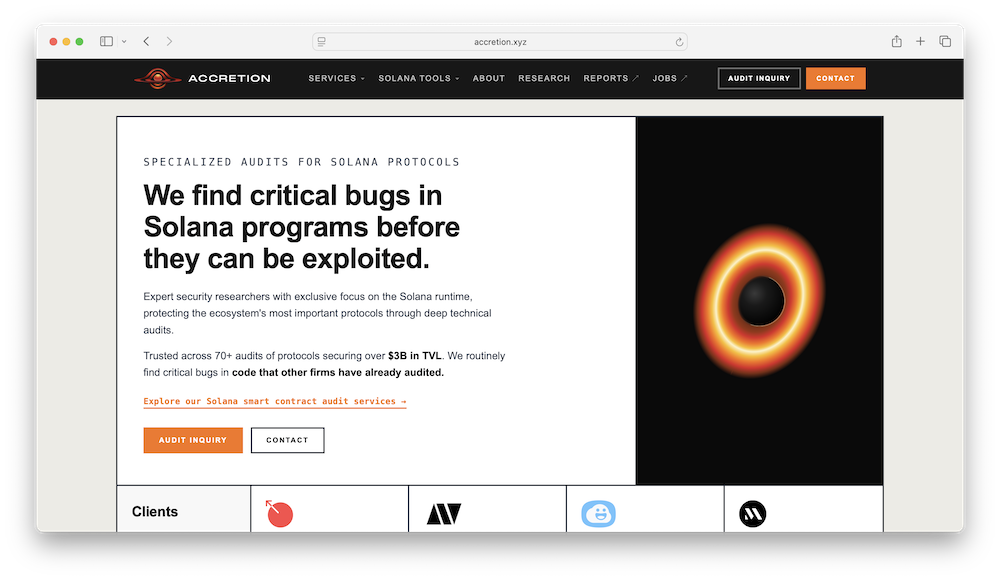
- Accretion.xyz is the online home of Accretion Labs, a security firm that reviews the code of Solana programs (the applications that run on the Solana blockchain) to find bugs before attackers can exploit them.
- The firm lists clients including governance and token launchpad platform MetaDAO, liquid staking infrastructure provider Sanctum, and the Solana Foundation.
- Accretion Labs reports 70+ audits completed since January 2025.
Accretion.xyz Overview
- What: Accretion Labs is a security firm that solely audits Solana programs.
- Why: The firm states that Solana’s runtime differs enough from the EVM, the system behind Ethereum, that it doesn’t believe one firm can lead on both.
- When: Robert Reith founded Accretion in January 2025, after spending two and a half years auditing Solana programs.
- Where: Accretion Labs lists its Singapore address in the footer of Accretion.xyz.
- How: The firm has eight offerings, from full program audits to operational security (opsec) reviews of a protocol’s keys and deployment process.
Fellow #GenXYZ Community Members Trust Accretion.xyz
- The homepage features testimonials from MetaDAO, Sanctum, digital asset protocol Metaplex, and Phoenix exchange developer EllipsisLabs.xyz.
- Public audits listed on the homepage include work for the Solana Foundation, Solana leverage and yield protocol Hylo, and yield optimization protocol YO.xyz.
Accretion.xyz Leadership
- Robert Reith: CEO and Lead Security Researcher
- Mahdi Rostami: Senior Security Researcher
- Niklas Brymko: Security Researcher
- Timur Dzhandzhhava: Associate Security Researcher
- Matej Hyčko: Associate Security Researcher
- Sven Welsch: Business Development
Connect with Accretion.xyz
Why .xyz is a great choice for Accretion.xyz
- Accretion.xyz gives the firm a distinctive online identity that matches its brand name exactly, one it carries across its GitHub organization (accretion-xyz) and X/Twitter handle (@accretion_xyz).
- A branded email address like [email protected] gives clients and collaborators a consistent point of contact that matches the firm’s website.
- .XYZ connects Accretion with the teams it works with: clients like YO.xyz and EllipsisLabs.xyz build on the same domain extension.
More emerging tech from the #GenXYZ community
- Security solutions provider Ackee.xyz aims to enhance blockchain integrity through audits and smart contract development
- Quantum computing startup QMatter.xyz aims to reduce complex problems for drug discovery and beyond
- AI-powered platform Outfield.xyz transforms orchard management with drone technology and data analytics
posted by Team XYZ on October 20, 2026
XYZ Registry’s Q3 2026 Anti-Abuse Quarterly Report is now available, highlighting our work with Netcraft and how its threat intelligence supports our efforts to identify and respond to DNS abuse.