posted by Team XYZ on September 28, 2026
Matter.xyz – Gandi customer – (United States)
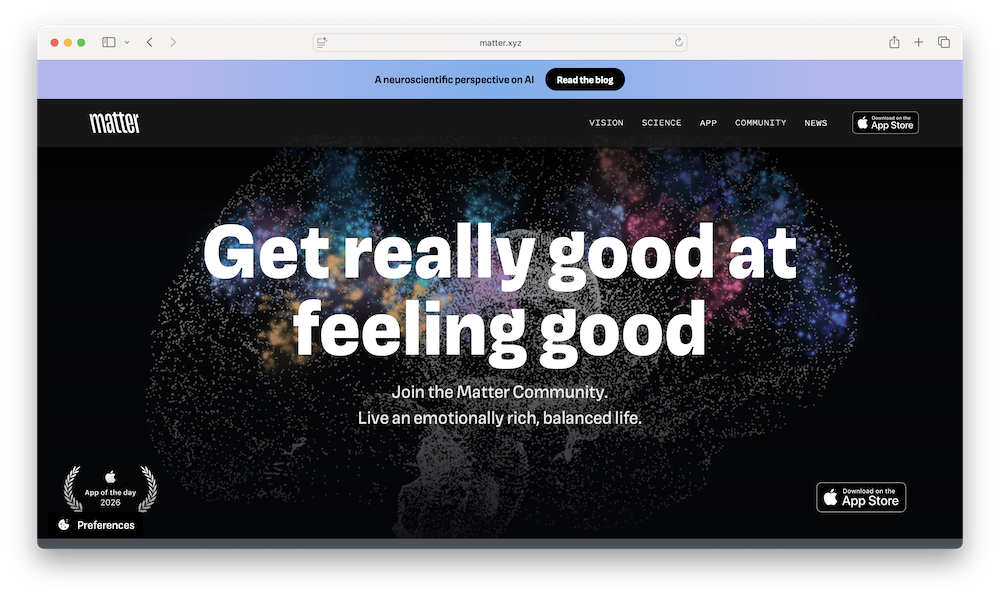
TL;DR:
- Matter.xyz is the online home of Matter Neuroscience, a company combining molecular neuroscience, brain imaging, and guided emotional training to help people improve their emotional well-being.
Matter.xyz Overview
- What: Matter Neuroscience describes itself as a company that combines molecular neuroscience, brain imaging, and guided emotional training.
- Why: According to the company, its work responds to what it describes as a growing mental health crisis, citing global data on the prevalence of major depressive disorder. Matter says it is working to identify a biological marker for happiness that could help guide people toward greater well-being.
- When: Matter Neuroscience was founded in 2019.
- Where: The company lists locations in Boulder, Colorado, and New York City.
- How: Matter’s iOS app uses an AI feature called “M” alongside neuroscience-based tools designed to help people track and strengthen their emotional fitness.
The Party Line
- The Party Line, an ongoing series of social experiments Matter began in early 2026, connects vintage payphones reprogrammed to call only each other. The first pairing linked San Francisco (“Call a Republican”) with Abilene, Texas (“Call a Democrat”), with the two cities selected based on 2024 presidential election data.
- The launch drew coverage from Texas Monthly, Axios, and ABC7 San Francisco. Texas Monthly reported approximately 350 conversations.
- Matter has since installed two additional pairings: Boston University students with residents of a senior living community in Reno, Nevada, and the Watts neighborhood of Los Angeles with Abbot Kinney Boulevard in Venice, California, to explore socioeconomic differences.
- In a July 20, 2026 profile, Upworthy quoted Matter co-founder Ben Goldhirsh on the idea that finding common ground can activate positive emotions and associated brain chemicals. Ben Goldhirsh previously held leadership roles at Upworthy and co-founded GOOD, its sister media brand under GOOD Worldwide.
How it Works
- Matter’s iOS app centers on six neurotransmitters it links to positive emotion (dopamine, testosterone, serotonin, oxytocin, cannabinoids, and opioids).
- An AI feature called “M” is designed to act as what the company calls a “partner in happiness,” helping people understand their brains and track emotional patterns.
- Users log positive “memories” and reflect on their emotional state, with the app connecting those entries to information about emotions and neurotransmitters and providing personalized guidance over time.
- A community feature called Joyalties helps members recognize each other’s role in their emotional well-being.
- The Matter app is available on the Apple App Store.
Venture Funding
- Matter Neuroscience emerged from stealth in February 2024 with $26M in total funding.
- An initial seed round led by Polaris Partners, followed by a round co-led by ARCH Venture Partners, Polaris Partners, and Exor Ventures, with participation from Collaborative Fund and others.
Matter.xyz Leadership
- Axel Bouchon: Co-founder and CEO; a biochemist and neuroscientist who previously led venture arms at Moderna and Bayer and serves as a venture partner at ARCH Venture Partners.
- Bridget Best: Chief Operating Officer; previously served as COO of home renovation platform Sweeten and spent more than five years as SVP of Operations at Kickstarter.
- Ben Goldhirsh: Co-founder and Chairman; also serves as the company’s Head of Product. He is also known for co-founding GOOD Worldwide and leading the Goldhirsh Foundation.
- Chris Shiflett: Co-founder, joining in 2021; also known for founding Faculty and co-founding the Brooklyn Beta conference.
- Daniela Schiller: Advisory board member; a neuroscientist in the Departments of Neuroscience and Psychiatry at the Icahn School of Medicine at Mount Sinai, one of Matter’s research partner institutions.
Connect with Matter.xyz
Why .xyz is a Great Choice for Matter.xyz
- Matter.xyz is a short and memorable domain name that is easy to type and share.
- The availability of .xyz helped Matter to pair its one-word brand name with a concise domain.
- The .xyz domain is used by companies and projects across science, technology, and wellness, connecting Matter.xyz with a broader range of ventures in the #XYZCommunity.
More bioscience technology from the #GenXYZ community
- Neurotech research platform PLNeuro.xyz, advised by Neuralink co-founder, drives investment and science into brain-computer interfaces
- Quantum computing startup QMatter.xyz aims to reduce complex problems for drug discovery and beyond
- Biotech innovator AscentBio.xyz seeks to advance drug discovery with AI-driven solutions
posted by Team XYZ on September 24, 2026
Anagram.xyz – GoDaddy customer – (Cayman Islands)
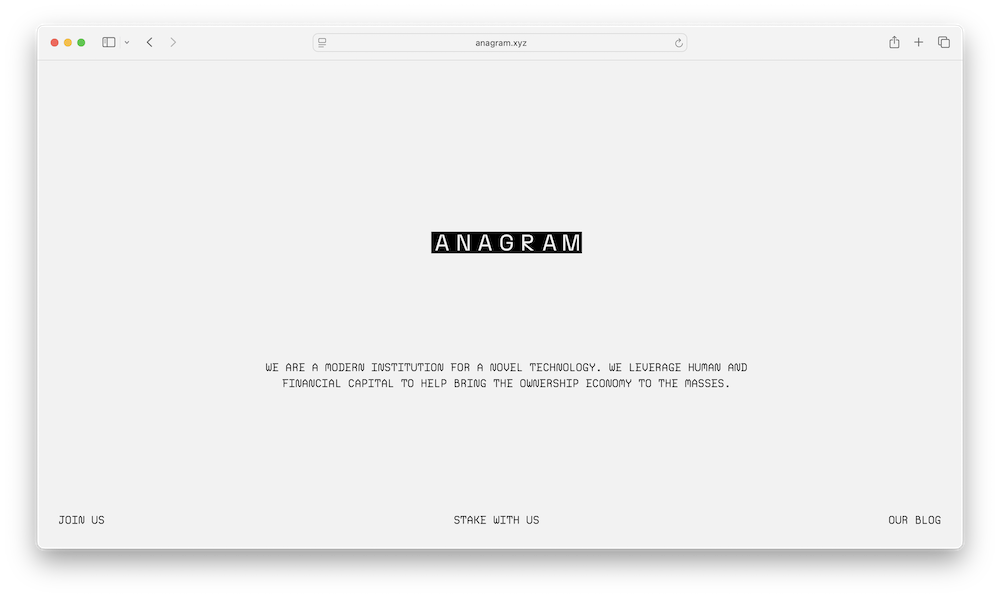
TL;DR:
- Anagram.xyz is the online home of Anagram, a digital assets holding company that develops and incubates crypto projects while also investing in and advising companies across the digital asset ecosystem.
- Founded in 2022, Anagram focuses on advancing blockchain technology and expanding participation in digital assets.
Anagram.xyz Overview
- What: Anagram is a digital assets holding company focused on building, incubating, investing in, and advising crypto projects.
- Why: Anagram is committed to advancing blockchain technology, with goals that include empowering individuals and communities in the ownership economy, accelerating the digitization and financialization of assets, and expanding participation in the digital asset ecosystem, according to the Overview section of its LinkedIn profile.
- When: The About section of Anagram’s LinkedIn profile states that the company was founded in 2022.
- How: Anagram’s model combines the development of its own crypto products with support for external projects and companies.
How it Works
- Anagram combines product development, incubation, investing, and advisory work within a single digital assets company.
- Build: Anagram develops crypto products and blockchain infrastructure through its in-house team, with projects spanning decentralized finance, Solana infrastructure, and other applications, as shared on its blog.
- Incubate: The company works on new crypto concepts internally and has also supported external founders through initiatives such as its Entrepreneur in Residence (EIR) program.
- Invest and advise: Anagram invests in and advises companies across the digital asset ecosystem. In March 2026, the firm participated in VeryAI’s $10M seed round, led by Polychain Capital.
Projects Built by Anagram.xyz
- Anagram Staking Services operates a Solana validator designed to help users directly delegate SOL while retaining custody of their stake. The platform provides validator performance metrics and offers additional reward structures for larger delegations.
- Glider is a non-custodial application for building and executing crypto trading strategies onchain.
- Bonsol is an open-source, Solana-native verifiable compute system designed to help developers create verifiable executables using private or public data and integrate the results into Solana smart contracts.
- Breeze is a non-custodial yield platform developed to help Solana-based applications integrate automated yield generation into their products.
Anagram.xyz Leadership
- JJ Alicea: President and General Partner. JJ joined Anagram in 2023 after serving as Head of Research at VegaX Technologies, where his work included quantitative and DeFi trading strategies.
- Caroline Jaquiss: Partner. Caroline joined Anagram in 2022 after spending five years as a Partner at blockchain-focused investment firm Polychain Capital.
- Joseph Eagan: Co-founder. Joseph co-founded Anagram in 2021 after serving as President of Polychain Capital from 2017 to 2021.
Connect with Anagram.xyz
Why .xyz is a Great Choice for Anagram.xyz
- .XYZ’s generic nature suits Anagram’s broad approach to digital assets, giving the company an adaptable online home for its work across building, incubation, investing, and advisory.
- Anagram.xyz is a memorable online identity that passes the radio test, easy to type and share.
- .XYZ is used by blockchain developers, protocols, investors, and technology companies, aligning Anagram’s online identity with a broader community working across blockchain and digital assets.
More blockchain support from the #GenXYZ community
- Investment group Mesh.xyz, founded by Ethereum co-founder Joseph Lubin, supports blockchain innovation
- Fortune-featured, women-led investment firm CrucibleCap.xyz backs early-stage digital infrastructure projects, from Sapience.xyz to DoubleZero.xyz
- VC firm Mirana.xyz invests in blockchain and AI infrastructure projects, from EigenCloud.xyz to Taiko.xyz
posted by Team XYZ on September 23, 2026
KellyBerry.xyz – GoDaddy customer – (France)
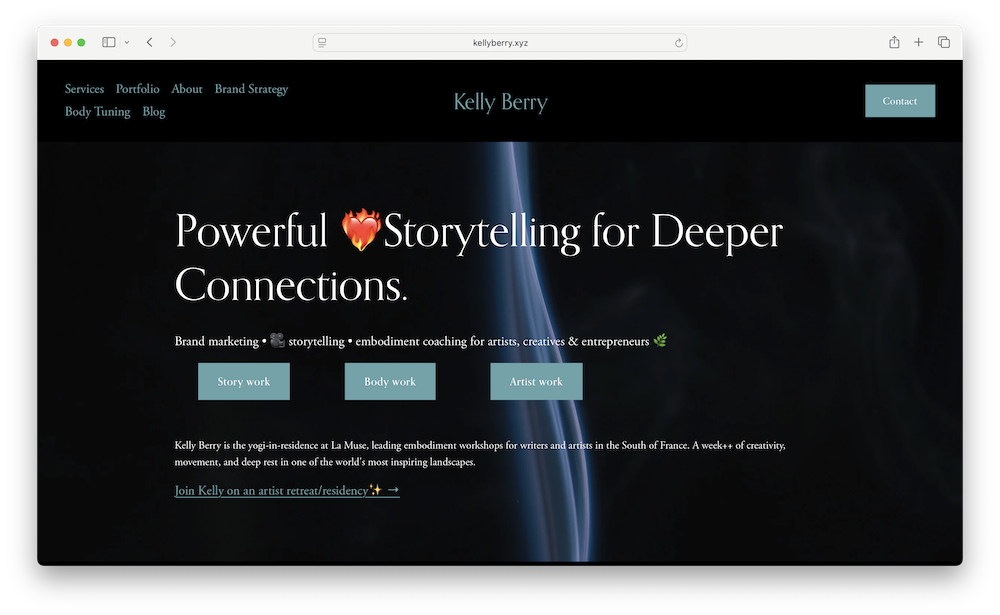
TL;DR
- KellyBerry.xyz is the personal website of Kelly Berry, a brand strategist, writer, and embodiment coach working across storytelling, communications, wellness, and creative projects.
- The website brings Kelly’s professional services, portfolio, writing, and Body Tuning coaching practice together in one online hub.
KellyBerry.xyz Overview
- Who: Kelly is a brand strategist, writer, and embodiment coach who works with artists, creatives, entrepreneurs, and brands.
- What: Kelly uses her .xyz to highlight how she combines brand strategy and storytelling with embodiment coaching.
- Brand and strategy services: positioning, messaging, verbal identity, content development, and writing and editing.
- Embodiment and wellness services: communications, meditation, and movement.
- Why: Kelly describes her mission as creating positive change through “story, strategy, and the wisdom of the body.”
- Where: Kelly is based in Paris and the south of France, working with clients across Europe and the United States, after previously living in New York and Washington, D.C.
Kelly’s Career and Education Background
- According to Kelly’s About page, she has worked as a communications strategist across health, wellness, and lifestyle brands. Prior roles include:
- Marketing Communications Director at email marketing platform Sailthru
- Associate and Social Media Strategist at Schmidt Public Affairs, where campaigns received a PRSA Silver Anvil Award and an IABC Gold Quill Award
- Director of Marketing at digital product agency Crush & Lovely
- Marketing and Communications Director at strategic consulting agency Forth Road Health
- Co-founder of Vibrobath OnDemand, a streaming meditation platform
- Education: Kelly holds a B.A. in English from The College of William & Mary and has completed more than 10,000 hours of training across movement disciplines, according to her About page.
Brand Strategy and Portfolio
- Kelly offers brand development services spanning positioning, messaging, verbal identity, brand guidelines, customer profiling, and strategic planning.
- Her services also include marketing campaigns, digital copywriting, writing and editing, and communications planning for brands and executives.
- Her Portfolio spans brand strategy, copywriting, and creative campaigns across wellness, lifestyle, health tech, real estate, and the arts.
- Examples include:
- Naming and brand identity work for jewelry brand RENNA
- A brand pivot and repositioning project for health-tech company Radian
- Lifestyle copywriting for Rosewood Residences Naples, in partnership with The Seventh Art Agency
- Experiential marketing and strategy for Scotch whisky brand Dewar’s
Body Tuning
- Body Tuning, also called the Kelly Berry Method, is Kelly’s personal embodiment coaching practice built around meditation, movement, and awareness.
- One-to-one sessions draw on yoga, Pilates, breathwork, sound, and somatic awareness, with each session adapted to the client.
- Body Tuning sessions are offered virtually and are open to all experience levels. The website also features a meditation library developed as part of the Kelly Berry Method.
- Kelly shares on KellyBerry.xyz that she is the yogi-in-residence at La Muse Writers & Artists Retreat in the South of France, where she leads embodiment workshops for writers and artists.
Writing and Creative Projects
- Kelly’s Blog features essays and articles on topics including brand storytelling, language, introspection, and personal development.
- The blog highlights Kelly’s inclusion in Extase, a Paris-based trilingual anthology.
- Kelly’s homepage also highlights her Shadow Work video podcast series, available on YouTube, which explores themes including self-awareness and personal development.
Connect with KellyBerry.xyz
The Value of a FirstNameLastName.xyz Domain like KellyBerry.xyz
- The availability of .xyz domains makes it easier to secure an exact match for a personal name, and using a FirstNameLastName.xyz domain like KellyBerry.xyz gives Kelly an online presence directly tied to her professional name and body of work.
- This naming approach can help clients, collaborators, and readers searching for her locate her online hub, spanning her brand strategy work, writing, and Body Tuning coaching practice.
- The generic nature of the .xyz domain gives Kelly an adaptable online home for the different areas of her work, from brand strategy and writing to embodiment coaching and creative projects.
More Creatives from the #GenXYZ community
- Art director and designer BonnieWang.xyz uses her .xyz to showcase bold, experimental work for SoulCycle, Adidas, and more
- Berlin-based photographer, director, and producer TimTyson.xyz uses his .xyz to showcase campaign work, artist portraits, and more
- BAFTA-winning filmmaker Will Anderson uses Wanderson.xyz to showcase films, commissions, and collaborations
posted by Team XYZ on September 21, 2026
PLTT.xyz – Whois Corp. customer – (South Korea)
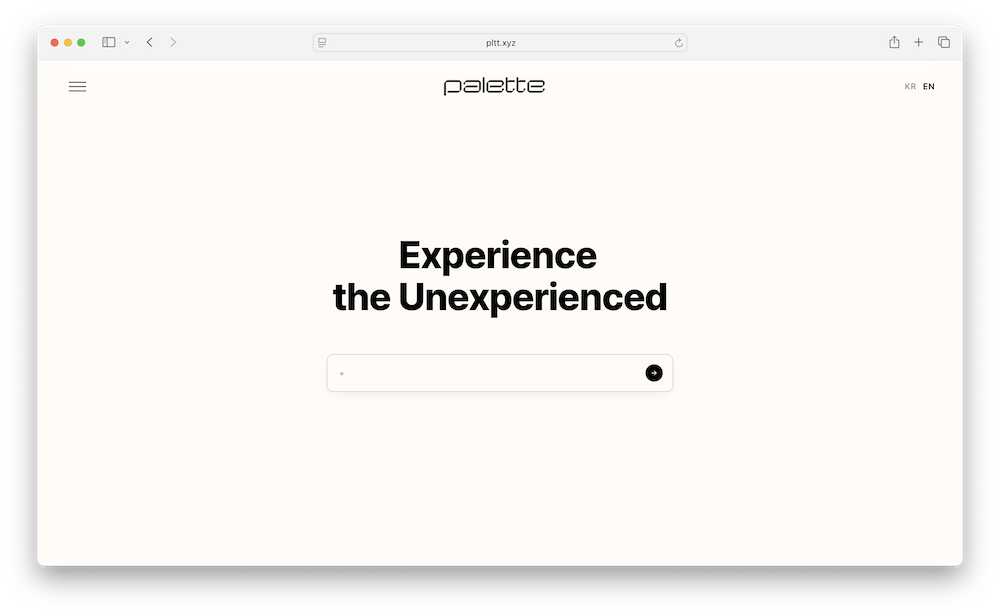
TL;DR:
- PLTT.xyz is the online home of Palette, a Seoul, Korea-based company developing AI agents and AI-powered creative solutions for marketing and advertising.
- Founded in 2018 as a video-focused advertising agency, Palette began developing AI solutions in 2022 and has since expanded operations to India and Singapore.
- PLTT.xyz is available to view in both Korean and English.
PLTT.xyz Overview
- What: Palette develops AI solutions designed around business workflows, marketing, advertising, and creative production. The company describes its approach as combining strategists, consultants, AI agents, and creative professionals.
- Why: In October 2025, CEO Jong-keun Lee told South Korean daily newspaper Dong-A Ilbo that his experience running a video-focused advertising agency highlighted limitations involving the time and cost required to produce content. The company began developing AI solutions after identifying opportunities to address those constraints.
- How: Palette’s AI offering is organized around two primary areas:
- Palette Agent: Custom AI agents designed around a company’s industry, brand, workflows, and operating structure.
- Palette Creative: AI-supported creative services designed to bring together creative directors, copywriters, art directors, producers, and directors with AI tools for advertising and brand content.
- When: According to the Dong-A Ilbo profile:
- 2018: The company began as a video-focused advertising agency.
- 2022: Palette began developing AI solutions and later combined its advertising production and AI platform development businesses.
- Where: PLTT.xyz lists Palette’s headquarters in Seoul, South Korea. The company has also expanded internationally:
- India: Palette established an AI research and development operation in India in 2022, according to Dong-A Ilbo.
- Singapore: The company later established a Singapore operation to support expansion in Asia, according to the same report.
PLTT.xyz Leadership
Connect with Palette
Why .xyz is a great choice for PLTT.xyz
- The short PLTT.xyz domain creates a memorable online identity that is easy to share and type, especially on mobile devices.
- The .xyz domain is globally recognizable, making it well suited to Palette’s international-facing communications.
- .XYZ is used by startups, technology platforms, and research organizations working across AI and other emerging technologies, connecting Palette with a global community building the next generation of technology.
More AI innovation from the #GenXYZ community
- Women-led hospitality platform AIVATech.xyz builds AI-powered intelligence for hotel operations
- Collaboration platform Buzz.xyz, from Jack Dorsey’s Block.xyz, gives human and AI teams a shared workspace
- AI-powered venture platform Surge.xyz supports project launch, validation, and capital raising for early-stage founders
posted by Team XYZ on September 17, 2026
Mantle.xyz – CSC customer – (Singapore)

TL;DR:
- Mantle.xyz is the online home of Mantle, an Ethereum Layer-2 network designed to connect real-world financial assets, like stablecoins and tokenized equities, to onchain capital markets.
- Previously, Mantle was BitDAO, a community-governed treasury in crypto, and rebranded from bitdao.io to Mantle.xyz after a community vote.
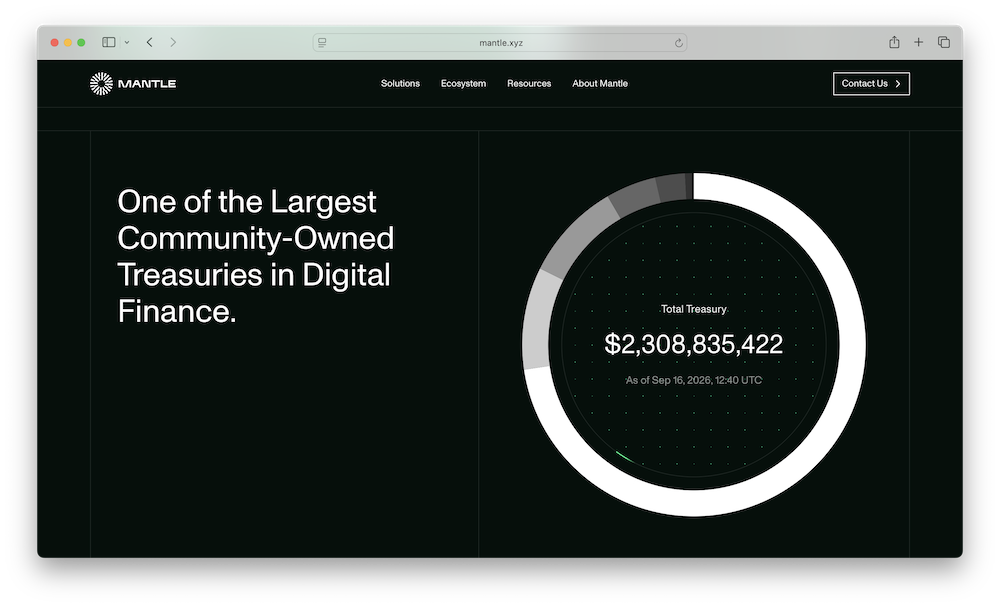
- As of September 2026, the network reports over $2.4B in its community-owned treasury.
Mantle.xyz Overview
- What: According to its website, Mantle is an open financial network designed to connect global market participants to institutional-grade capital market assets onchain.
- Why: Mantle says it aims to give both institutions and individual users borderless access to global capital markets, connecting traditional finance with onchain liquidity.
- When: Mantle’s mainnet launched in July 2023.
- How: Mantle runs as a Layer-2 network, meaning it processes transactions on its own faster, cheaper system, then settles the results back to Ethereum for security.
How it works
- Mantle is built to be compatible with Ethereum’s software (specifically, the OP Stack, a shared codebase several other Ethereum scaling networks also use), so contracts written for Ethereum can run on Mantle without changes.
- In September 2025, the network changed how it proves those transactions are valid: it moved from a model that assumes transactions are correct unless challenged, to one that uses cryptographic “zero-knowledge” (ZK) proofs to confirm validity upfront.
- Governance happens through Snapshot, an off-chain voting tool that lets MNT token holders weigh in on decisions without paying transaction fees.
Company Updates
- Mantle’s own blog (September 2025): Mantle said it cut its bridge withdrawal window from seven days down to about six hours by migrating to a zero-knowledge (ZK) validity rollup built with Succinct’s SP1 zkVM.
- PRNewswire (February 2026): Mantle announced completion of the ERC-8004 standard on mainnet, a protocol it says supports a decentralized AI agent economy.
- PRNewswire and Newswire.ca (April–May 2026): Mantle announced partnerships with Bybit and xStocks to bring tokenized U.S. equities on-chain, later adding an “Atomic RFQ” system for minting and redeeming those tokens directly.
Venture Funding
- Before rebranding to Mantle, BitDAO raised $230M in a private funding round in 2021, with participation from Founders Fund, Pantera Capital, and Dragonfly Capital, among others.
Mantle.xyz Leadership
- Mantle does not have a conventional founder or CEO. It is governed by a decentralized community of $MNT token holders, with day-to-day direction shaped by a group of core contributors and advisors. Notable figures include:
- Ben Zhou: Co-founder and CEO of the Bybit exchange. Ben is credited, alongside community member jacobc.eth, with proposing the initial concept that became Mantle in 2022. He is not an employee or executive of Mantle itself, but is described in Mantle’s own communications as a strategic advisor to the network.
- Jordi Alexander: Holds the title of Chief Alchemist at Mantle, a role in which he advises on product and economic strategy across the ecosystem. He is also the founder of Selini Capital, a digital-asset trading and venture firm. Jordi leads MantleX, the network’s AI research and incubation arm.
- Yaxi Zhu: Co-founder of Bybit and Founding Partner at Mirana.xyz. Yaxi leads the development of Mantle Banking, a blockchain-based financial services initiative within the Mantle ecosystem.
Connect with Mantle.xyz
Why .xyz is a great choice for Mantle.xyz
- Mantle.xyz gives Mantle a short and memorable online identity, easy to type and share.
- The generic nature of the .xyz domain provides Mantle with the room to represent an evolving ecosystem, one that now spans a Layer-2 network, a liquid staking protocol, a Bitcoin yield primitive, and an AI research arm, all under one domain.
- As a widely recognized extension among blockchain and web3 projects, .xyz fits naturally alongside Mantle’s positioning as infrastructure for onchain finance.
More DeFi innovation from the #GenXYZ community
- Research lab Allez.xyz builds risk analytics and strategic advisory tools for DeFi protocols
- Layer-2 blockchain Atlas.xyz aims to deliver low-cost, reliable solutions for verifiable finance
- Ethereum credit protocol 3Jane.xyz develops fintech lending infrastructure